






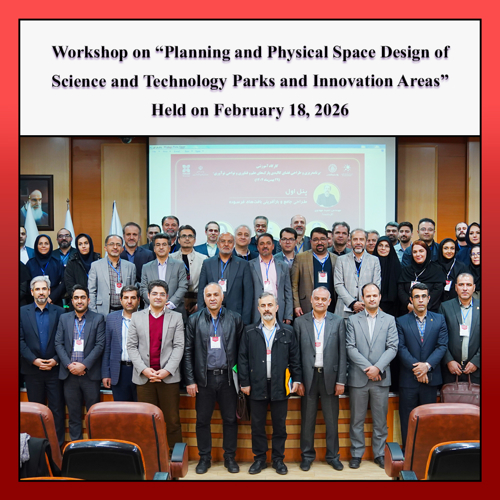
Workshop on Planning and Physical Space Design of Science and Technology Parks and Innovation Areas Held on February 18, 2026
The workshop on Planning and Physical Space Design of Science and Technology Parks and Innovation Areas was held with the participation of park executives, civil and infrastructure experts, board members of the Association, authors of the book "Planning and Physical Space Design of Science and Technology Parks and Innovation Areas" and professionals active in the innovation ecosystem.
At the opening session, Dr. Behnam Talebi, Chairman of the Board of the Iran Association of Science Parks and Innovation Organizations, welcomed participants and emphasized the critical importance of structured and forward-looking planning in the development of science and technology parks. He highlighted that sustainable park development requires strategic alignment between physical expansion, governance models, and innovation policies.
Dr. Mostafa Mafi, President of the ICT Park, addressed the legal and executive requirements for park development. He underlined that physical expansion must be based on an approved master plan and carried out through qualified consultants and formal provincial review processes. Infrastructure costs—including utilities, energy supply, and technological backbone—often exceed construction costs, making private sector participation and innovative financing models essential for sustainable development.
Dr. Ali Motamedzadegan introduced the book Planning and Physical Space Design of Science and Technology Parks and Innovation Areas, describing it as a product of accumulated professional and executive experience. He stressed that planning must precede construction and that what is visible in buildings and urban form is the outcome of deep strategic groundwork. The importance of balancing “hardware” (physical infrastructure) and “software” (services, programs, and innovation ecosystem dynamics) was repeatedly emphasized.
Panel I: Integrated Design and Urban Regeneration
The first panel explored comprehensive design approaches and the regeneration of urban fabrics in relation to science and technology parks. Discussions focused on the evolution of park generations, the integration of parks within urban contexts, and the increasing role of private sector participation.
Speakers highlighted that modern parks are no longer merely physical compounds but interconnected innovation networks. Fourth-generation parks, in particular, incorporate accelerators, venture capital funds, incubators, and digital services into a more complex ecosystem structure. The concept of the park as a service network—rather than just a geographical site—was strongly emphasized.
Urban integration was identified as a key factor in next-generation innovation areas. Rather than being located exclusively on city outskirts, innovation districts can contribute to urban regeneration, social revitalization, and economic dynamism when embedded within city centers. Open innovation systems, active public spaces, and multi-centered urban development models were discussed as essential design principles.
Panel II: Urban Innovation Districts – Parks of the Future
The second panel addressed the transformation of science and technology parks toward future-oriented, intelligent, and city-based models.
A central theme was the unique identity (“fingerprint”) of each park and the need to redefine organizational structures in response to rapid technological change. Speakers stressed that parks must evolve from isolated entities into integrated urban actors while maintaining flexible governance frameworks.
Emerging technologies—particularly Artificial Intelligence and Digital Twin systems—were presented as transformative tools in the planning and management of future parks. AI can support data-driven space forecasting, infrastructure optimization, energy efficiency, and financial planning. Digital Twin technologies enable real-time simulation of infrastructure performance, crisis scenarios, and development strategies, potentially reducing development costs by 20–30 percent.
The role of behavioral economics in spatial design was also discussed. Concepts such as “nudge,” “default,” and “friction” can shape user behavior through spatial configuration without imposing rigid control. However, flexibility in design must be structured and scenario-based to avoid functional ambiguity.
Inclusivity and social innovation were highlighted as fundamental principles. Parks should accommodate diverse user groups—including women, elderly individuals, and people with disabilities—while balancing openness with privacy and collaborative interaction. Context-sensitive architectural responses to climate and local culture were also considered essential.
The panel concluded that future science and technology parks must:
Possess a distinctive identity while remaining deeply connected to their urban context;
Integrate AI and Digital Twin technologies into planning and governance;
Employ data-driven decision-making and smart policy frameworks;
Balance physical infrastructure with ecosystem services;
Promote inclusivity, sustainability, and adaptive governance models.
Overall, the workshop underscored the necessity of structural, technological, and cultural transformation in Iran’s science and technology parks. The future park is envisioned not merely as a physical complex, but as an intelligent, network-based, and city-integrated innovation platform that enables sustainable growth and long-term ecosystem resilience.
View the latest news list
Postponement of the 6th National Conference
Saudi Arabia to Host the 29th Asian Science Park Association (ASPA) Annual Conference 2026
The 6th National Conference of the Iran Association of Science Parks and Innovation Organizations (STPIA) will be held in Winter 2026, hosted by Hormozgan Science and Technology Park.
Call for Applications Opens for the 2nd Dogiyan Award
Workshop on Planning and Physical Space Design of Science and Technology Parks and Innovation Areas Held on February 18, 2026
The 28th ASPA Annual Conference Closed in Bangkok
Iran Association of Science Parks and Innovation Organizations (STPIA) published: Planning and Physical Space Design of Science and Technology Parks and Innovation Areas
The Fifth National Conference of Iran Association of Science Parks and Innovation Organizations
The 5th National Conference of STPIA – Countdown to Innovation in the Age of AI
42nd IASP World Conference held in Beijing